When an Omaha Basement Wall Cracks or Leans In
A basement wall is built to stand straight against the soil. When it starts to crack sideways or tip inward at the top, the soil is winning, and bowing basement wall repair is about giving the wall back the strength it has lost.
Sealing a crack in a basement wall typically costs $200–$1,000, while stabilizing a wall that has bowed runs $4,000–$15,000 with carbon fiber strips or helical tiebacks (Fixr, 2026). Each tieback is about $1,500–$2,000. A wall that has moved too far may need digging out and rebuilding, which costs more.
What the crack pattern says
- Horizontal crack in block or poured concrete, often a third to halfway up the wall: soil pushing from outside. This is the crack to take most seriously.
- Stair-step cracks through block mortar: either the same inward push or one corner settling. Checking whether the wall is plumb helps tell which.
- Vertical crack in a poured wall: often shrinkage from curing. Fine if it stays thin and dry; worth sealing if it leaks.
- Diagonal crack from a window corner, wider at one end: points to settlement under that part of the wall.
- Loose or crumbling stone, brick or tile in a prewar basement: mortar loss and moisture, usually over decades.
What does bowing basement wall repair involve?
Injection fills a crack in a poured wall from the inside face to the soil side. Epoxy bonds the concrete; polyurethane foam flexes and stops seepage. Neither stops a wall from moving.
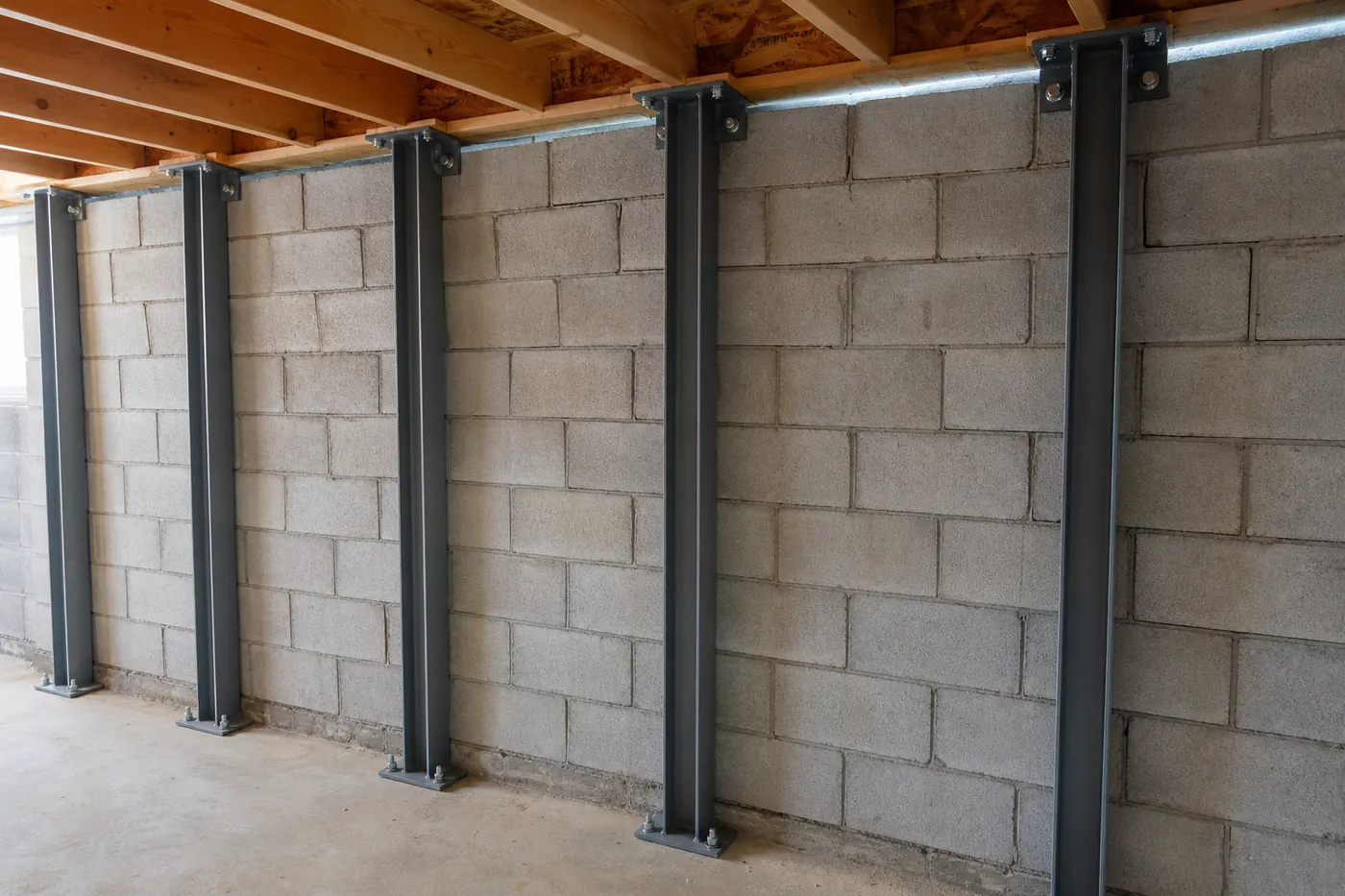
Carbon fiber or steel strips are fixed to the inside face of the wall at intervals, floor to joists. They suit walls with modest bowing and take up little room.
Wall anchors and helical tiebacks reach through the wall into the soil outside and hold it from there. Anchors use a plate buried out in the yard; tiebacks are screwed into the ground.
Excavation and rebuilding is for walls that have moved too far to hold. The soil is dug away, the wall straightened or relaid, and drainage added before backfilling.
Why Omaha walls carry so much side load
Omaha's housing is old enough that many basement walls are block, brick or tile rather than poured concrete: about 61% of the city's homes were built before 1980, and close to 18% before 1940 (U.S. Census ACS 2020–2024). Those walls are strong under weight from above but weaker against pressure from the side. Add soil that is soaked in May and June, when Eppley Airfield averages well over 4 inches of rain a month, then frozen through much of winter (NOAA normals), and the push on the wall changes all year.
Before the specialist arrives
Hold a long level or hang a string line against the wall to see whether it leans in at the top. Mark each crack's ends with a pencil and the date, and photograph them beside a ruler after heavy rain. Note where the nearest downspout empties. The Omaha foundation repair price table shows what each method typically costs.
Questions homeowners ask
Can I just patch a horizontal crack?
Patching hides it but doesn't stop the push behind it. A horizontal crack means the wall is carrying more side load than it was built for. Fix the drainage that feeds the soil, then have the wall assessed for bracing or anchoring.
Get your Omaha basement looked at
Describe the wall, the water or the crack, and which part of the house. A single independent foundation specialist in Omaha will phone you back to go over it and find a time to look.