Built on Wind-Blown Silt: Omaha's Loess and Your Basement
The hills Omaha sits on are made largely of loess soil, silt that wind carried here during the ice ages. That ground holds a house well when it stays put and drains, and it is worth understanding before you decide why a basement wall has cracked.
Most of Douglas County's upland soil formed in loess, a fine wind-blown silt: 58% of the county's soil acreage with a recorded parent material is loess, and 37% is river and creek alluvium (USDA NRCS). The NRCS rates about 38% of rated land "very limited" for houses with basements, mostly for slope, shrink-swell, flooding or a high water table.
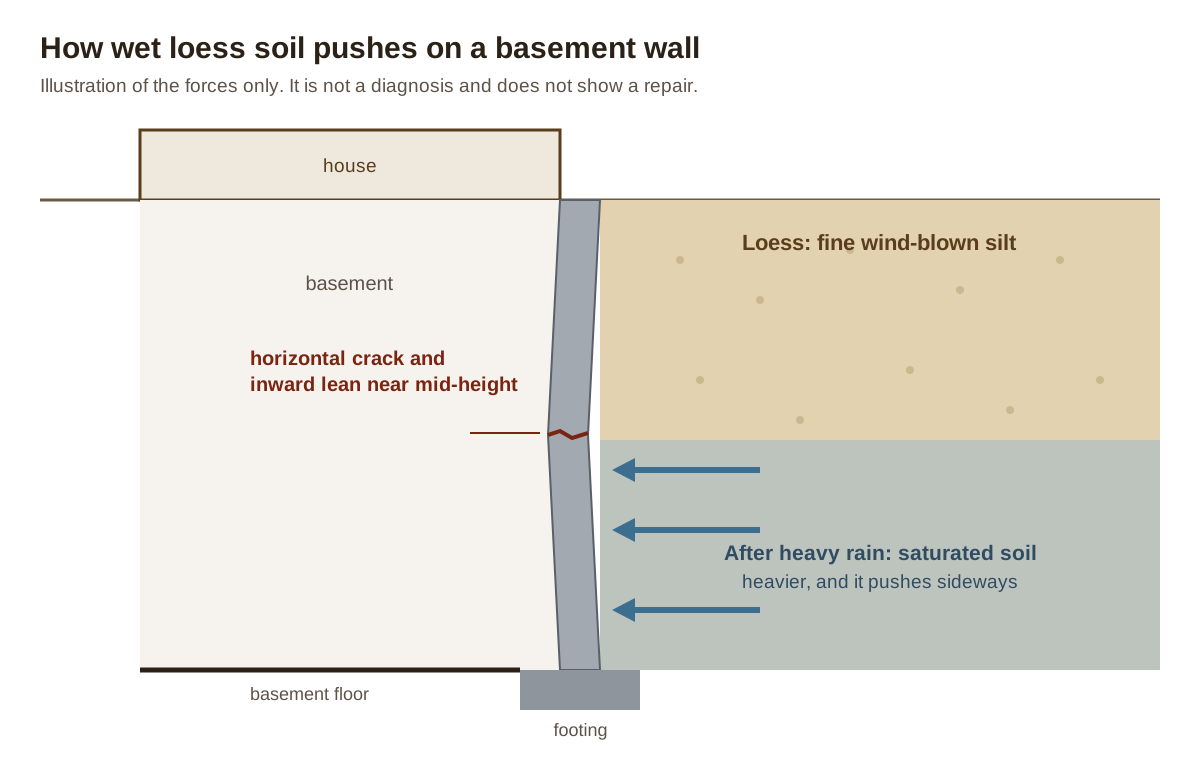
What is loess soil?
Loess is silt-sized dust that wind lifted from river floodplains and spread in sheets over the land. Around Omaha, the younger Peoria Loess covers much of the upland between streams, and the older Loveland Loess shows in a few small areas in the east (USGS surficial geologic map of the greater Omaha area). The county's most common natural soils, including Contrary, Marshall and Monona silt loams, formed in it (USDA NRCS soil survey).
Silt drains more slowly than sand, erodes easily when bare, and changes volume somewhat as it wets and dries. None of that makes it poor ground to build on. It does mean that how water is handled around a house matters a great deal.
How the soil survey rates basements
The NRCS rates every soil for "dwellings with basements." In Douglas County, by acreage of the soils it rates:
- Very limited: 37.7%
- Somewhat limited: 44.8%
- Not limited: 17.5%
The reasons it cites most are slope, shrink-swell, flooding and depth to a saturated zone, in that order. About a quarter of the county's mapped land, mostly ground the survey classes as urban land, is not rated at all, because the original soil there has been disturbed (USDA NRCS, Douglas County soil survey).
Four ways the ground shows up in a basement
- Hillside lots. Slope is the most common limitation. A house cut into a hill has more soil against its uphill wall, and runoff heads straight for it.
- Shrink and swell. Soil that swells when wet and shrinks when dry loads a wall unevenly, can open a gap along it, then presses back in.
- Low ground by the river and creeks. Alluvial soils carry the flooding and high-water ratings. The Missouri River at Omaha crested at 36.29 feet on July 2, 2011, and 34.4 feet on March 17, 2019, against a flood stage of 27 feet (NWS).
- Fill. Backfill against a basement wall keeps settling for years. Where it slumps, water pools beside the foundation.
Weather adds the load
More than half of Omaha's yearly precipitation, 17.25 of 31.86 inches at Eppley Airfield, falls from May through August, and about 135 days a year drop to freezing or below (NOAA 1991–2020 normals). Silt that is soaked in early summer and frozen in winter puts a changing load on a basement wall every year.
What to do with this
You can look up the soil under your own lot in the USDA's Web Soil Survey. Whatever it shows, the useful steps are the same: keep downspouts and grading carrying water away, watch walls for sideways cracks and inward lean, and act early. Read about repairing bowing and cracked basement walls and waterproofing an Omaha basement, and compare prices in the 2026 Omaha cost guide.
Get your Omaha basement looked at
Describe the wall, the water or the crack, and which part of the house. A single independent foundation specialist in Omaha will phone you back to go over it and find a time to look.